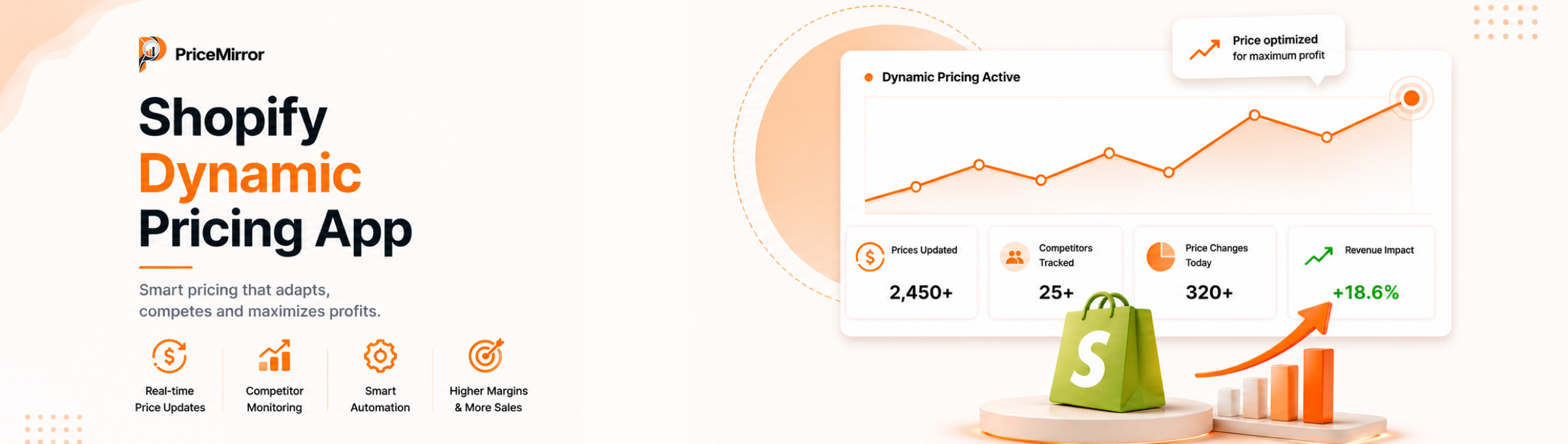
Shopify Dynamic Pricing App: The Complete Guide for Shopify Stores (2026)
Prices don't sit still anymore. Your competitors adjust theirs several times a day, demand shifts by the hour, and stock runs out without warning. Trying to keep up by editing prices manually in your Shopify admin is a losing game, especially once your catalog grows past a few dozen products. That's the gap a Shopify dynamic pricing app fills: it watches the market for you and adjusts your prices automatically, inside rules you control.
This guide covers everything you need to know before choosing one: what a Shopify dynamic pricing app actually is, how dynamic pricing works under the hood, the benefits and real-world use cases, the features that separate a good app from a frustrating one, and why Price Mirror is a strong fit for stores that want pricing to drive conversions, not just automate busywork.
What is a Shopify dynamic pricing app?
A Shopify dynamic pricing app is a tool that automatically changes your product prices based on live market signals rather than leaving them fixed until you edit them by hand. Those signals usually include competitor prices, demand, inventory levels, and time or season. You set the rules; the app does the constant watching and adjusting.
It helps to draw a line between this and two things it is often confused with. A bulk price editor changes many prices at once, but only when you tell it to, and it doesn't react to anything happening in the market. A discount or sale app schedules promotions, again on your manual say-so. A dynamic pricing app is different because it is signal-driven and continuous: it reprices on its own when a competitor moves, when demand spikes, or when a rule you defined is triggered.
On Shopify specifically, a good dynamic pricing app installs directly into your admin, syncs with your existing product catalog, and updates prices automatically within the minimum and maximum limits you set, with no coding required. The most common input by far is competitor pricing, which is why many of these apps are really competitor price trackers with an automated repricing engine attached.
How dynamic pricing works
Behind the scenes, every dynamic pricing app follows the same basic loop, even if the polish varies from tool to tool.
- Data collection. The app monitors your chosen signals. For competitor-based pricing, you add the URLs of competing product pages and the app tracks them on a schedule. It can also read your own demand, sales velocity, and stock levels.
- Rules engine. You define how you want to compete: match a competitor, beat them by a set amount, or stay a certain percentage above. Crucially, you set a minimum and maximum price so automation can never push you below a profitable floor.
- Decision. The app compares your current price against the live signals and your rules, then works out whether a change is needed and what the new price should be.
- Repricing. It updates the price in Shopify automatically, or flags a suggested change for you to approve, depending on how hands-off you want to be.
- Feedback. Price history, change alerts, and analytics show you what moved and why, so you can refine your rules over time.
Within that loop, stores use several dynamic pricing strategies, often in combination:
| Strategy | Responds to | Example |
|---|---|---|
| Competitor-based | Rival price changes | Match or beat a competitor the moment they drop a price on a shared product |
| Demand-based | Traffic and sales velocity | Raise the price slightly on a product that is selling fast |
| Time-based | Schedule or season | Apply automatic weekend, holiday, or peak-season pricing |
| Inventory-based | Your stock levels | Nudge the price up as a low-stock item gets scarce |
| Margin-based | Your costs and floors | Never allow automation to price below your set margin floor |
Most Shopify stores start with competitor-based pricing and layer in the others as they get comfortable.
Benefits of using a dynamic pricing app
Done well, dynamic pricing affects both sides of your profit equation at once: it protects margin while helping you win more of the sales you are currently losing on price.
- Protect your margins automatically. Min and max guardrails mean prices adjust to the market without ever dropping below what your business needs to make.
- Stay competitive without a race to the bottom. You react to competitor moves within your own rules instead of blindly undercutting.
- Save hours of manual work. No more checking competitor tabs or bulk-editing prices by hand every week.
- React to the market in near real time. When a competitor drops a price or sells out, the app responds far faster than any human could.
- Capture margin when you can. If a rival raises prices or goes out of stock, dynamic pricing lets you hold or lift your price to make the most of it.
- Make decisions with data. Price history and analytics turn guesswork into informed pricing strategy.
Use cases: who benefits most

A dynamic pricing app earns its keep fastest in these situations:
- Competitive niches with shared products. Electronics, supplements, beauty, and fashion stores that sell the same SKUs as many rivals live or die on price positioning.
- Dropshipping and reselling. When dozens of stores carry identical products, staying priced right is often the only lever you have.
- Large catalogs. Once you have hundreds or thousands of products, manual pricing simply isn't possible, and automation becomes essential.
- Seasonal and promotional selling. Automate peak-season, weekend, or holiday pricing instead of scrambling to update it live.
- Multi-channel sellers. Stores selling on Shopify plus marketplaces need consistent, competitive pricing across all of them.
- Stores losing shoppers to price-checking. If customers keep leaving to compare prices elsewhere, the right app can both keep you competitive and show that fact on the page.
Features to look for in a Shopify dynamic pricing app
Not every app in this category is built the same. These are the features worth insisting on:
- Real-time competitor tracking from any website, not just a few marketplaces.
- Automated repricing with clear, flexible rules (match, beat, or hold a position).
- Minimum and maximum margin guardrails so automation stays profitable.
- Change alerts so you know the moment a competitor moves.
- Price history and analytics to refine your strategy over time.
- An on-page price comparison option that shows shoppers you are competitively priced, which most apps skip entirely.
- A no-code, Shopify-native setup that runs inside your admin.
- Reliable price reading, plus a free plan or trial so you can test accuracy on your own competitors before paying.
Why Price Mirror

Most dynamic pricing apps stop at the admin dashboard. They track competitors and reprice in the background, which is useful, but they never touch the moment where stores actually lose the sale: when a shopper leaves your product page to compare prices somewhere else. Price Mirror is built to close that gap.
It does the full dynamic pricing job first. Price Mirror tracks competitor prices in real time, reprices automatically against the rules you set, and enforces your minimum and maximum limits so your margins stay protected. Then it does the part almost no other app offers: it displays a live competitor price comparison right on your product pages, so customers can see you are competitively priced without ever leaving to check. The same data that protects your margins also becomes an on-page reason to buy.
What stands out
- Real-time competitor tracking plus fully automated repricing
- Min/max rules and margin protection built in
- On-page price comparison widget that turns pricing into conversions
- Runs entirely inside Shopify admin with no coding
- A 5.0 Shopify App Store rating, a free plan to start, and paid tiers from $39/month
It's worth being straight about fit: Price Mirror is a newer app, so it has fewer reviews than long-established players, and its lower tiers are sized for small to mid catalogs rather than enterprise-scale ones. For most Shopify stores that want competitor-driven dynamic pricing and want that pricing to help win the sale on the page, that trade is an easy one to make.
Try Price Mirror free on the Shopify App Store →
Frequently asked questions
What is dynamic pricing on Shopify?
Dynamic pricing on Shopify means automatically adjusting your product prices in response to live signals like competitor prices, demand, or stock levels, rather than keeping them fixed. A dynamic pricing app handles the monitoring and the price changes for you, within limits you set.
Does Shopify have built-in dynamic pricing?
Shopify doesn't include competitor-based dynamic pricing out of the box. You can edit prices and schedule discounts manually, but to track competitors and reprice automatically you need a dedicated app from the Shopify App Store, such as Price Mirror.
Will dynamic pricing hurt my profit margins?
Not if it's set up properly. Every reputable dynamic pricing app lets you define minimum and maximum prices, so automation can react to the market without ever pushing a price below your profitable floor. The guardrails are what keep dynamic pricing safe.
Is dynamic pricing legal?
Yes. Adjusting your own prices in response to publicly listed competitor prices is a standard, widely used part of retail. You're reacting to information competitors display openly to their own shoppers. The sensible practice is to stay within your own margins rather than triggering a price war.
Can I try a Shopify dynamic pricing app for free?
Often, yes. Price Mirror offers a free plan, and most competing apps offer a free trial. Starting with a free option is the best way to test how accurately an app reads your specific competitors before committing to a paid plan.
How is a dynamic pricing app different from a discount app?
A discount app applies sales and promotions when you tell it to. A dynamic pricing app is continuous and signal-driven: it changes prices on its own based on competitor moves, demand, or your rules, without you having to trigger each change.
The bottom line
A Shopify dynamic pricing app takes one of the hardest, most time-consuming parts of running a store and turns it into an automated, rules-based system that protects your margins and keeps you competitive around the clock. Start with your highest-revenue products, set your guardrails before you automate anything, and choose an app that fits your catalog size and goals. If you want your pricing to do more than run quietly in the background, and actually help convert shoppers on the page, Price Mirror is built for exactly that, and it's free to try.