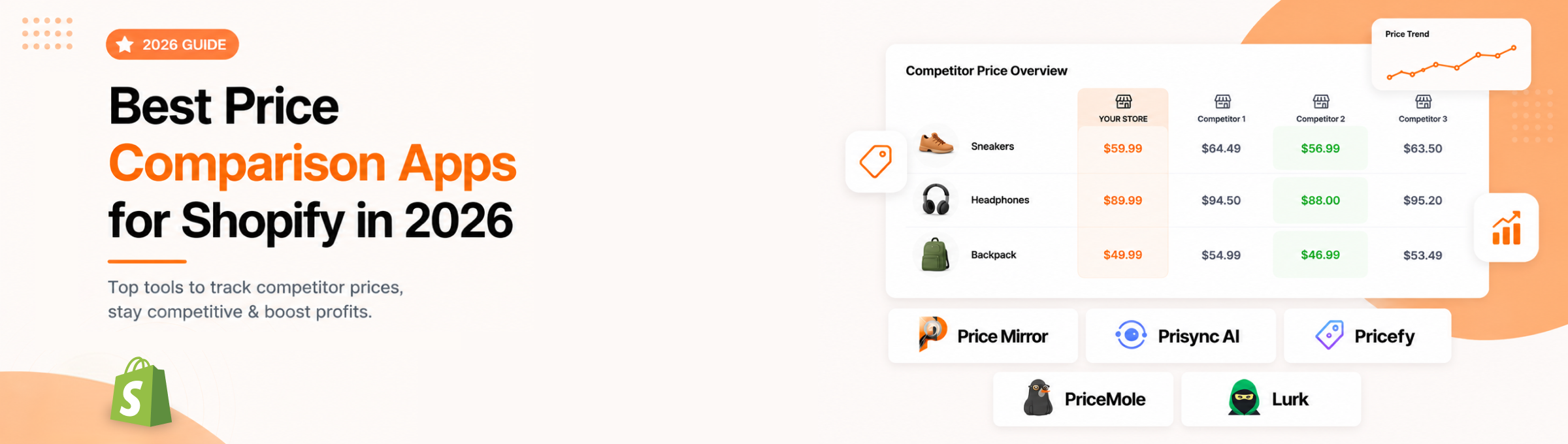
Best Price Comparison Apps for Shopify in 2026 (Compared)
Pricing is one of the few levers that moves both your conversion rate and your margin at the same time. Get it right and shoppers buy from you instead of clicking away to compare; get it wrong and you either leave money on the table or lose the sale entirely. That is why a good price comparison app has become close to essential for serious Shopify stores.
But the apps in this category are not all built for the same job. Some are heavy-duty competitor price trackers for large catalogs, some focus on automated repricing across marketplaces, and some are better at turning pricing data into a clearer buying decision on the page. Below, we compare the best price comparison apps for Shopify on features, pricing, ratings, and who each one actually suits.
Quick comparison
Here is the shortlist at a glance. Ratings and pricing below were checked against the Shopify App Store on July 6, 2026.
| App | Best for | Rating | Starting price | Free option |
|---|---|---|---|---|
| Price Mirror | Tracking + on-page price comparison | 5.0 (7) | Free / $39 mo | Free plan |
| Prisync AI | Large catalogs & multi-channel | 4.9 (224) | $49 / mo | Free trial |
| Pricefy | AI competitor matching on a budget | 4.7 (79) | Free plan | Free plan |
| PriceMole | Automated repricing across marketplaces | 4.8 (32) | $99 / mo | Free trial |
| Lurk | Simple, lightweight tracking | 3.9 (4) | Free plan | Free plan |
Figures were verified from official Shopify App Store listings on July 6, 2026. Check each listing for the latest pricing, review counts, and plan limits.
How we chose the best price comparison apps
A price comparison app is not just about scraping numbers. We weighed each one on the things that actually change results for a Shopify store:
- Tracking accuracy and coverage: how reliably it reads competitor prices, and whether it can track any website or only certain marketplaces.
- Automation: background monitoring, alerts on changes, and automated repricing so you are not checking manually.
- Margin protection: min/max rules and guardrails so pricing decisions stay profitable.
- Conversion impact: whether the app can turn pricing data into something shoppers see, not just a back-office report.
- Pricing and value: entry cost, free options, and what you get at each tier.
- Ratings and reviews: real merchant feedback on the Shopify App Store.
The 5 best price comparison apps for Shopify
1. Price Mirror: Best Overall for Tracking + On-Page Comparison
Rating: 5.0 (7 reviews) | Pricing: Free plan; Basic $39/mo; Standard $139/mo | Free: Free plan available
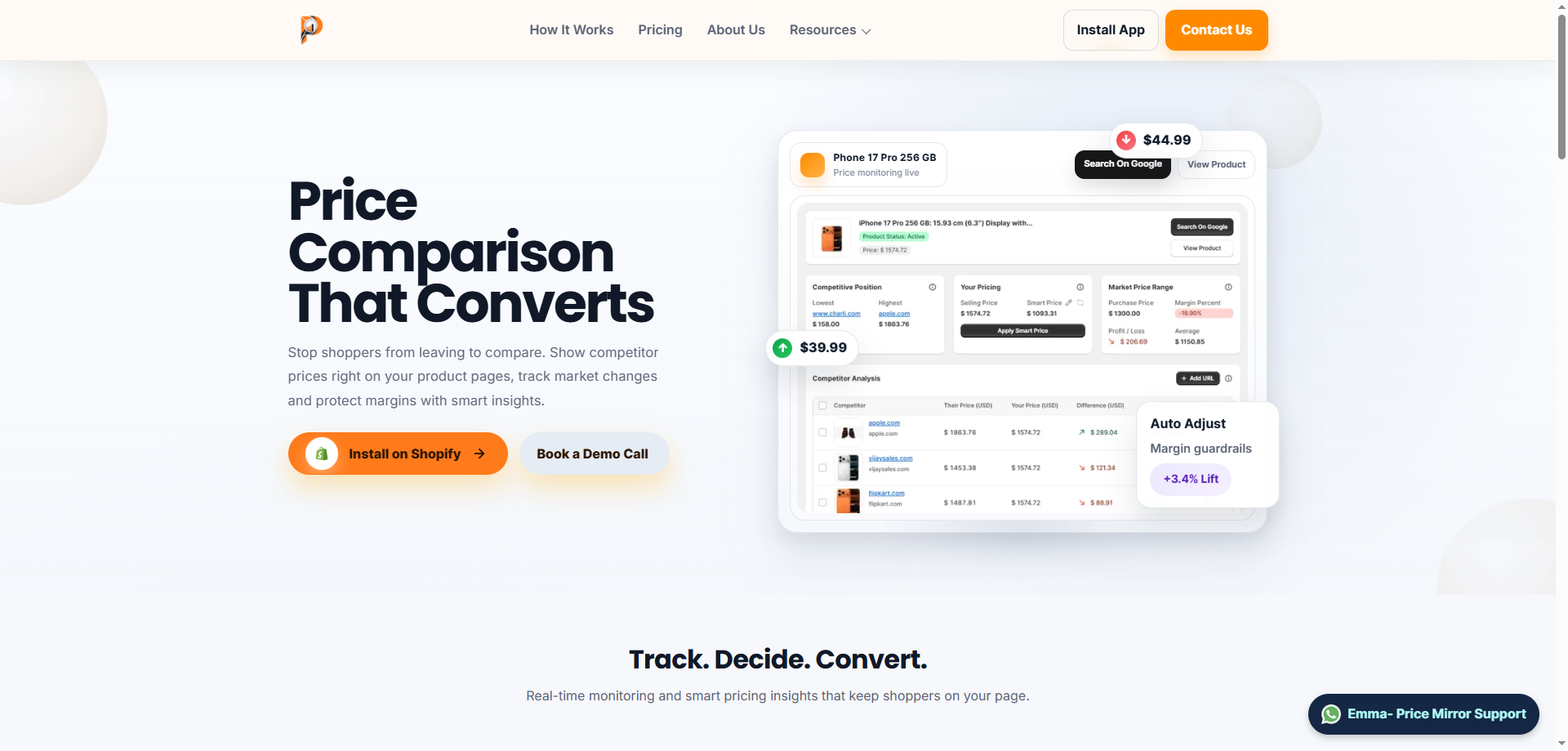
Most price comparison apps stop at the admin dashboard. They tell you what competitors charge, then leave it there. Price Mirror stands out by tracking competitor prices in real time and displaying a live price comparison right on your product pages, so shoppers can see you are competitively priced without leaving to check elsewhere. That pairing of competitor intelligence and an on-page trust signal is where many stores lose sales, and it is what puts Price Mirror at the top for conversion-focused Shopify brands.
Key features
- Real-time, fully automated competitor price tracking
- On-page price comparison widget shown directly to shoppers
- Min/max price rules to protect margins automatically
- Auto-repricing and price matching
- Price history, alerts, trend analysis, and an analytics dashboard
- Runs entirely inside Shopify admin with no coding
Pros
- Pairs competitor pricing with a visible on-page conversion tool
- Perfect 5.0 rating and easy no-code setup praised by reviewers
- Lower entry price than Prisync and PriceMole, with a real free starting option
- Margin guardrails keep automated pricing safer
Cons
- Newer app, so it has fewer reviews than long-established players
- Product-count limits on lower tiers suit small-to-mid catalogs best
Best for: DTC and mid-size Shopify stores that want to track competitors and use pricing to convert shoppers on the page, not just reprice in the background.
View Price Mirror on the Shopify App Store →
2. Prisync AI: Best for Large Catalogs & Multi-Channel Sellers
Rating: 4.9 (224 reviews) | Pricing: From $49/mo (higher tiers and add-ons cost more) | Free: 14-day free trial
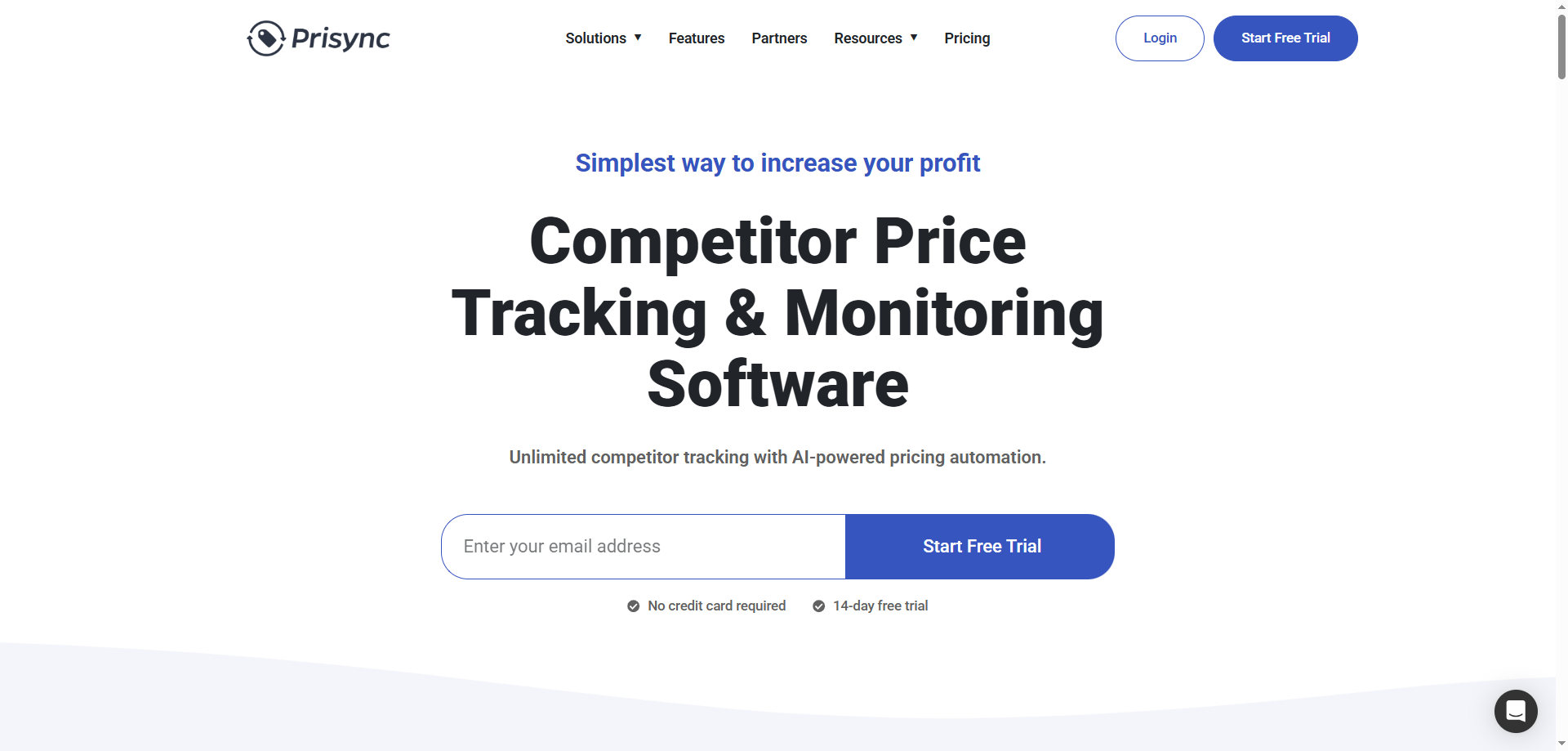
Prisync is the veteran of this category, with by far the largest review base in this list and a strong 4.9 rating to match. It tracks an unlimited number of competitors from virtually any website and across channels like Amazon, Google Shopping, and Shopify, then feeds that into dynamic repricing. If you run a large catalog and need serious depth like category and brand reports, frequent updates, and multi-channel coverage, Prisync is the most proven option.
Key features
- Unlimited competitor tracking from any website
- Multi-channel monitoring across Amazon, Google Shopping, and Shopify
- Dynamic pricing and automated repricing
- Category and brand-level reports
- Single dashboard with one-click import and continuous sync
Pros
- Most established and widely reviewed app in the category
- Excellent multi-channel and large-catalog coverage
- Consistently praised onboarding and support
Cons
- Gets expensive at scale because higher tiers and channel-based tracking add meaningful cost
- Built primarily for back-office monitoring and repricing rather than storefront messaging
Best for: Established retailers and larger catalogs that sell across multiple channels and need deep, proven competitor intelligence.
View Prisync AI on the Shopify App Store →
3. Pricefy: Best for AI Product Matching on a Budget
Rating: 4.7 (79 reviews) | Pricing: Free plan available | Free: Free plan
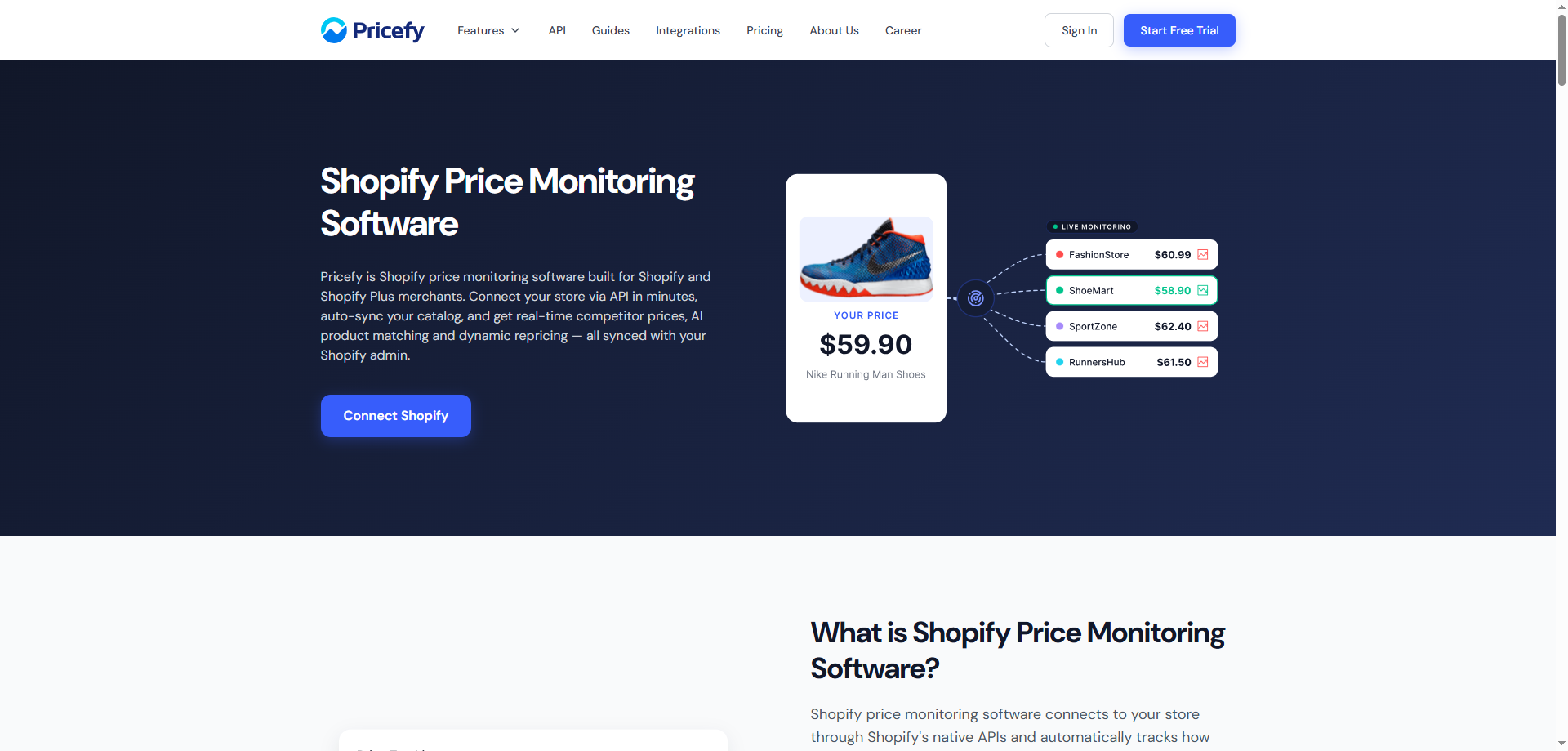
Pricefy leans on AI to discover competitors across the web and automatically match their products to yours, which cuts down a lot of manual link-hunting. It monitors both price and stock changes, sends custom alerts, and supports auto-repricing rules. With a free plan to start, it is a budget-friendly entry point, though some reviewers have flagged scraping reliability issues on certain sites, so it is worth testing against your specific competitors first.
Key features
- AI-powered competitor discovery and automatic product matching
- Price and stock-change monitoring
- Custom alerts and scheduled reports
- Auto-repricing rules with analytics charts
Pros
- AI matching cuts down manual setup time
- Free plan makes it easy to trial
- Tracks stock levels, not just price
Cons
- Some reviews report inconsistent scraping on certain sites
- No standout storefront comparison experience in the core positioning
Best for: Smaller and mid-size stores that want AI-assisted competitor matching without a big upfront commitment.
View Pricefy on the Shopify App Store →
4. PriceMole: Best for Automated Repricing Across Marketplaces
Rating: 4.8 (32 reviews) | Pricing: From $99/mo | Free: 14-day free trial
PriceMole is built around automated repricing and dynamic pricing, with the ability to monitor competitors across marketplaces like Amazon, eBay, Google Shopping, and Walmart alongside direct-to-consumer sites. It is a capable, well-reviewed tool for stores that want pricing to adjust itself based on rules. The main tradeoff is cost: its entry tier is the highest starting point in this list, which makes it better suited to stores with enough volume or margin to justify the spend.
Key features
- Competitor price monitoring across multiple marketplaces
- Automated repricing and dynamic pricing rules
- Historical pricing data and trend tracking
- Alerts on competitor changes
Pros
- Strong marketplace coverage across major channels
- Solid, hands-off repricing automation
- Good reputation for support
Cons
- Highest entry price of the apps here, starting at $99/mo
- More enterprise-leaning than smaller stores typically need
Best for: Multi-marketplace sellers who want automated repricing and can justify a higher monthly spend.
View PriceMole on the Shopify App Store →
5. Lurk: Best for Simple, Lightweight Tracking
Rating: 3.9 (4 reviews) | Pricing: Free plan available | Free: Free plan
Lurk keeps things simple: add a URL and its AI crawler starts tracking that page, whether it is another Shopify store, Amazon, Walmart, or any other site. It offers dynamic pricing rules and price-history reports without much setup overhead. It is newer with only a handful of reviews, so it is best viewed as a lightweight, low-cost way to start tracking a smaller set of competitors.
Key features
- AI crawler tracks prices on any website via URL
- Customizable dynamic pricing rules
- Competitor price-history reports and graphs
- Quick, low-friction setup
Pros
- Very easy to set up and start tracking
- Free plan and support for marketplace URLs
Cons
- Small review base means it is still lightly proven at scale
- Lighter reporting depth than bigger platforms
Best for: Stores that want a straightforward, inexpensive tracker for a small set of competitors.
View Lurk on the Shopify App Store →
How to choose the right price comparison app
The best app depends less on a feature checklist and more on what you are trying to fix. A few quick guides:
- If shoppers keep leaving to compare prices, prioritize a tool that brings comparison onto the page. Price Mirror is built around that use case.
- If you run a large, multi-channel catalog, Prisync's depth and unlimited tracking will serve you best.
- If budget is the priority, start with a free plan from Price Mirror, Pricefy, or Lurk before committing.
- If you want more hands-off repricing across marketplaces, PriceMole is purpose-built for that workflow.
Whatever you pick, start with your 20-30 highest-revenue products, set margin guardrails before automating anything, and decide in advance how you will respond when a competitor moves. A tool only pays off when it feeds a clear pricing decision.
Frequently asked questions
What is the best price comparison app for Shopify?
For most Shopify stores, Price Mirror is the strongest all-round option because it combines competitor tracking with a storefront-facing price comparison widget. Prisync is the strongest fit for large, multi-channel catalogs, while Pricefy and Lurk are easier budget-friendly starting points.
Is there a free price comparison app for Shopify?
Yes. Price Mirror, Pricefy, and Lurk all offer free plans, and the other apps in this list offer free trials. A free plan is the easiest way to test tracking accuracy against your own competitors before you upgrade.
Can these apps show competitor prices to my customers?
Some can. Price Mirror makes on-page comparison a core part of the product, while Lurk mentions a price comparison table and PriceMole lists an embeddable comparison widget. Many competitor tracking tools, though, still focus mainly on dashboard reporting and automated repricing inside the admin workflow.
Do I need coding skills to use a price comparison app?
No. The apps in this list are designed to install and run inside your Shopify admin without development work. Setup is usually adding your products and competitor links, then defining the pricing rules or alerts you want.
The bottom line
Every app on this list can help you keep an eye on competitor pricing, and the right one depends on your catalog size, budget, and what you want pricing to do for you. If your goal is simply to monitor a large catalog across channels, Prisync is hard to beat. But if you want pricing data to help win the sale on the page, Price Mirror's mix of real-time tracking, margin protection, and an on-page comparison widget makes it the standout choice for 2026.
Start free with Price Mirror on the Shopify App Store →