How to Track New Product Launches From Competitors
Your competitors are adding new products all the time, and the longer it takes you to notice, the more ground you give up. A rival quietly launches a product in a category you own, builds momentum for weeks, and you only find out when a customer mentions it. Tracking competitor product launches closes that gap. It tells you what rivals are adding, when, and in which categories, so you can spot trends early, protect your share, and decide how to respond while it still matters.
This is a different discipline from price tracking. Instead of watching what competitors charge, you are watching what they sell, and how their range changes over time. This guide covers why it matters, exactly what to look for, the free and automated ways to track competitor product launches, and how to turn what you find into action.
Why track competitor product launches?
Knowing what competitors launch, and when, is one of the most useful forms of market intelligence a store can have. It helps you:
- Spot trends and demand early. A wave of competitors launching in the same category is a strong signal of where demand is heading.
- Avoid being blindsided. You find out about a competitor's new product from your own monitoring, not from a customer asking why you don't carry it.
- Inform your own assortment. Competitor launches reveal gaps in your range and ideas for what to stock or develop next.
- Respond faster. Early awareness gives you time to react with your own product, positioning, marketing, or pricing before the launch gains traction.
- Benchmark your range. Tracking launches over time shows how your catalog compares to the market and who is expanding fastest.
What counts as a launch signal
A product launch is not always a loud announcement. The signals worth watching include:
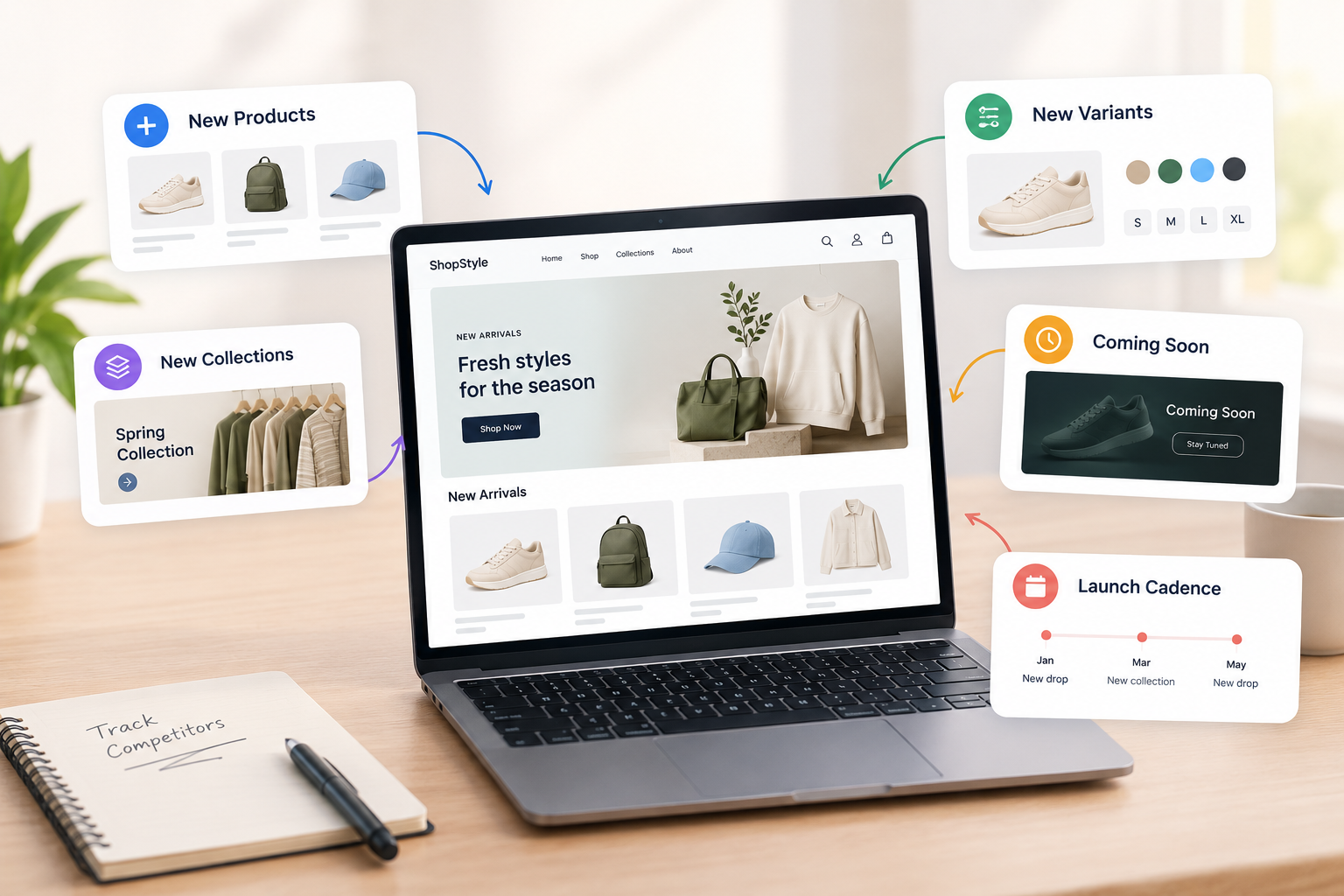
- New products added to their catalog, the most direct signal, often appearing on a New Arrivals page.
- New collections or categories, which can indicate a bigger strategic move into a new segment.
- New variants or line extensions of existing products, such as new sizes, colors, or bundles.
- "Coming soon" teasers and restocks, which hint at what is about to drop or what is selling well enough to bring back.
- Launch cadence, how often and when a competitor releases new products, which reveals their rhythm.
How to track competitor product launches
You can track launches for free with a bit of routine, or automate it with tools. Most stores combine a few of these.
Free methods
- Monitor their New Arrivals pages. Most stores have a "New" or "New Arrivals" collection. Bookmark your competitors' and check them on a schedule.
- Subscribe to their newsletters. Product launches almost always come with email campaigns, so signing up puts their announcements straight in your inbox.
- Follow their social media. Brands tease and announce launches on Instagram, TikTok, Facebook, and X before and as products go live.
- Watch their ads. The Meta Ad Library is free and public, and shows the ads any brand is running. New products usually get an ad push, which makes ads an early tell.
- Set up Google Alerts. Create alerts for a competitor's name alongside words like "new" or "launch" to catch press, blog posts, and announcements.
- Monitor their sitemap. A store's sitemap (often at /sitemap.xml, with Shopify product URLs in a products sitemap) lists its pages. New product URLs show up there, frequently before they are promoted anywhere.
Tools and automation
- Website change detection. Tools like Visualping and Distill watch specific pages, such as a competitor's New Arrivals page or navigation, and alert you when something changes, so you don't have to check manually.
- Competitor catalog platforms. Dedicated ecommerce intelligence tools such as Panoramata and Particl monitor a competitor's full catalog, promotions, and launches automatically, and present them in one searchable place.
Here is how the main methods compare:
| Method | What it catches | Effort |
|---|---|---|
| New Arrivals page checks | New products as they go live | Low (manual) |
| Email newsletters | Promoted launches and campaigns | Low (manual) |
| Social media and the Meta Ad Library | Launches they are actively pushing | Low to medium |
| Google Alerts | Press, blog posts, announcements | Low (set once) |
| Sitemap monitoring | New product URLs, often early | Medium (technical) |
| Change detection (Visualping, Distill) | Changes to arrivals, nav, and key pages | Medium |
| Catalog platforms (Panoramata, Particl) | Full catalog and launches, categorized | Higher (paid) |
How often to check
Match your cadence to how fast each competitor moves. A practical rhythm is to check New Arrivals pages and sitemaps weekly, keep social and ad monitoring running continuously through alerts, and review the bigger picture monthly. When you first start watching a new competitor, check daily for a couple of weeks to learn their normal pattern, so genuine launches stand out from routine changes.
Turning launch signals into action
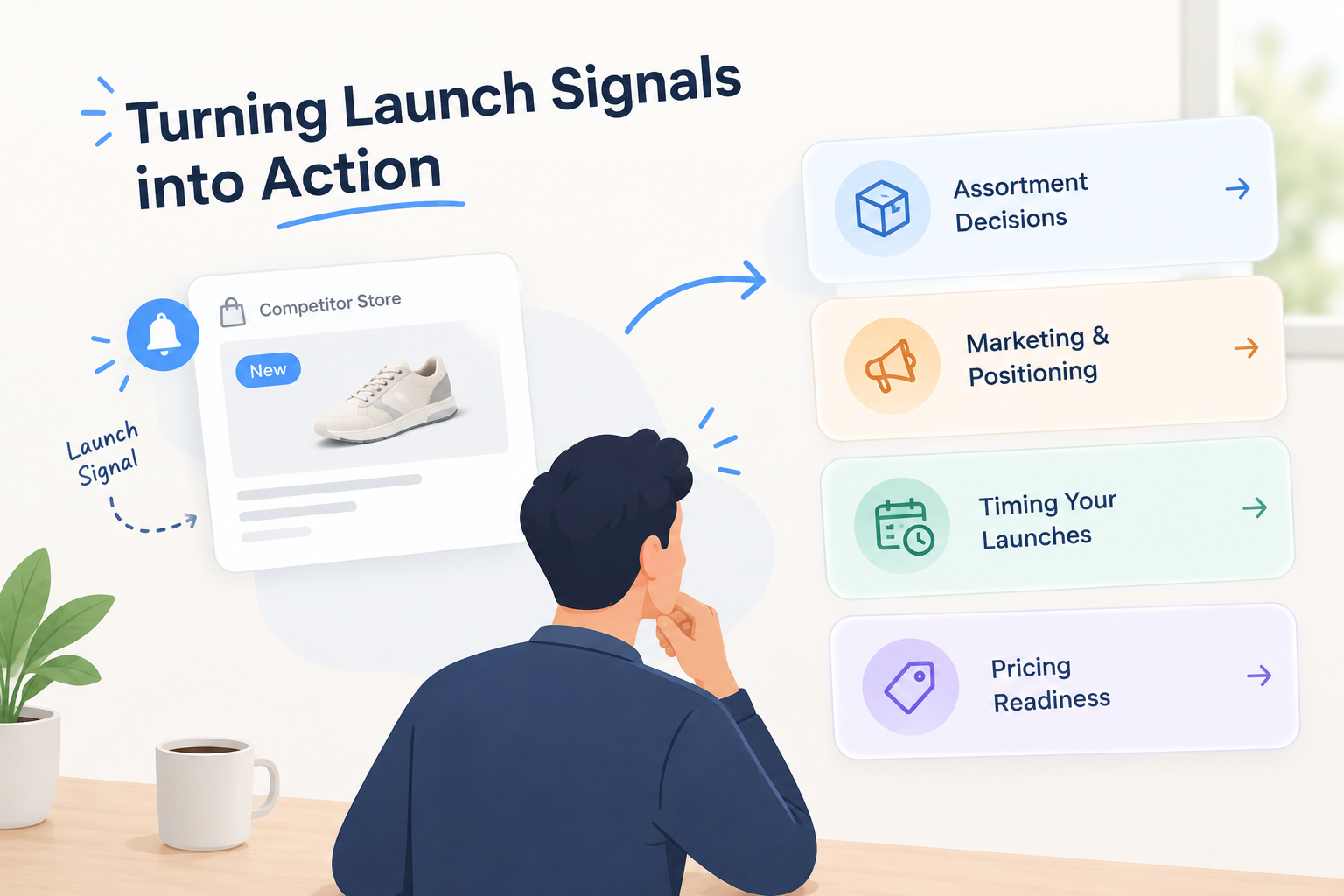
Tracking only pays off if you act on what you find. When you spot a competitor launch, it usually points to one of a few responses:
- Assortment decisions. Decide whether to stock a similar product, fill the gap they just revealed, or hold your position.
- Marketing and positioning. Adjust your messaging or campaigns to defend the category or highlight what makes your version better.
- Timing your own launches. Use their cadence and gaps to plan when to release your own products for maximum impact.
- Pricing readiness. When a competitor launches something you also sell, you need to know whether you are priced competitively on it.
The pricing follow-through
Spotting a launch is only half the job. The moment a competitor launches a product you already sell, or decide to stock in response, the next question is pricing: are you competitive on it? That is a different discipline from launch detection, and it is where ongoing competitor price monitoring earns its place.
Price Mirror is one tool that handles this side. It tracks competitor prices in real time and reprices within your margin rules, so once a product overlaps with your catalog, you stay competitively priced on it without checking by hand. It covers the pricing response rather than the launch detection itself, which means it works alongside the monitoring methods above rather than replacing them.
See how Price Mirror tracks and matches competitor prices on the Shopify App Store →
Best practices
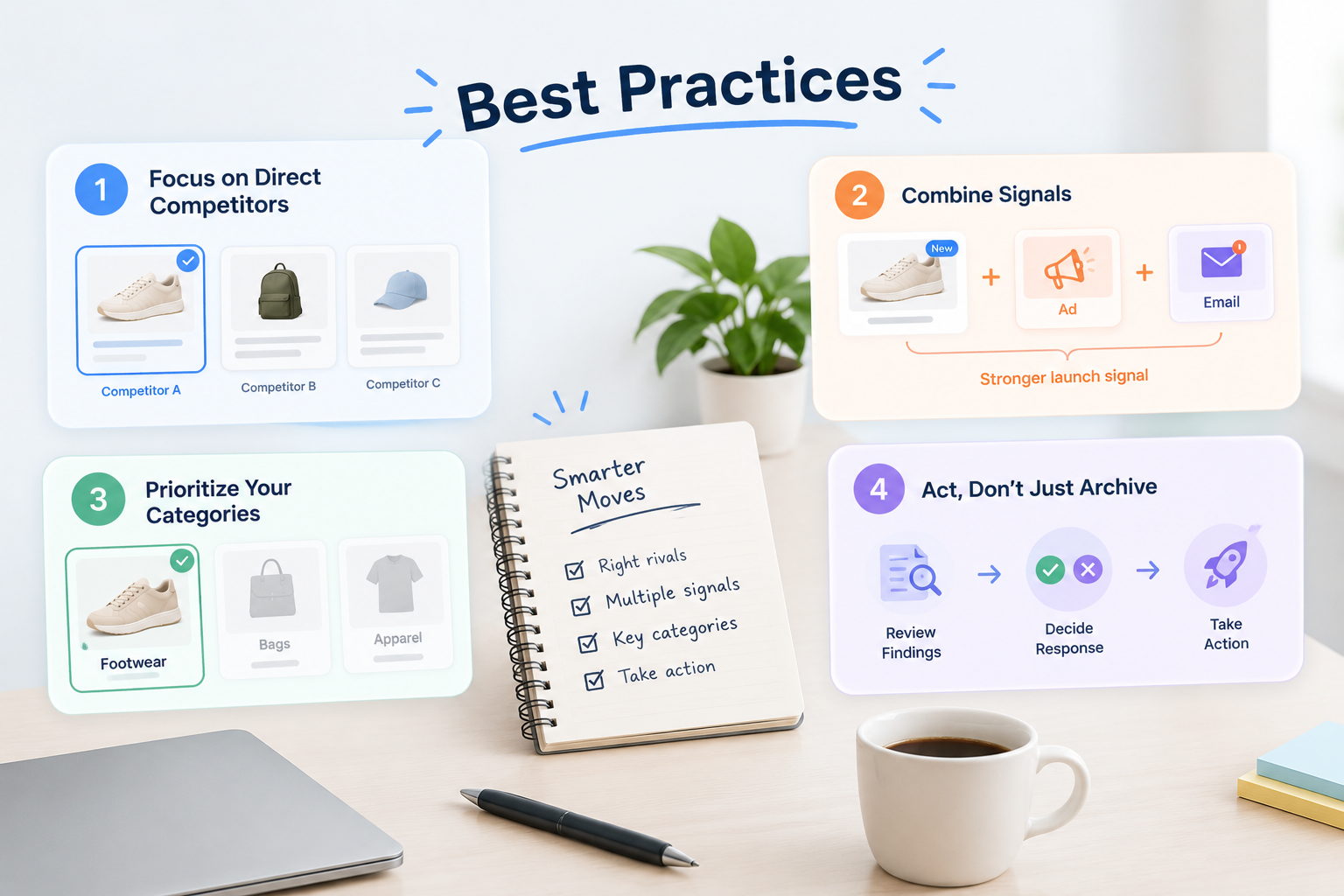
- Focus on direct competitors. Track the handful of rivals who genuinely compete for your customers rather than every store in your space.
- Combine signals. A new product page plus a matching ad and email is a confident launch; one signal alone can be a quiet test.
- Prioritize categories you care about. Watch most closely the categories where you actually compete or plan to expand.
- Act, don't just archive. Monitoring you never act on is wasted. Build a simple habit of reviewing findings and deciding a response.
Frequently asked questions
How do I know when a competitor launches a new product?
Watch the places launches show up: their New Arrivals pages, email newsletters, social media, and ads, plus their sitemap for new product URLs. Combining a free method like newsletter and social monitoring with a change-detection tool catches most launches early.
Can I track competitor product launches for free?
Yes. Subscribing to competitor newsletters, following their social accounts, checking the free Meta Ad Library, setting Google Alerts, and monitoring their New Arrivals pages and sitemap all cost nothing. Paid tools mainly add automation and save you time.
What is the best tool to track competitor products?
It depends on your needs. For catching page changes, website monitors like Visualping or Distill work well. For full catalog and launch tracking across many competitors, dedicated platforms like Panoramata or Particl automate the job. Small stores often start with free methods and add a tool as they scale.
How often should I check competitors for new products?
Check New Arrivals pages and sitemaps weekly, keep social and ad alerts running continuously, and review the broader picture monthly. When you start monitoring a new competitor, check daily for a couple of weeks to learn their normal pattern first.
How is tracking product launches different from price tracking?
Tracking product launches is about what competitors sell and how their range changes, which informs your assortment and strategy. Price tracking is about what they charge, which informs your pricing. Both matter, and they work together: launches tell you what to watch, and price tracking keeps you competitive on the products you share.
The bottom line
Tracking competitor product launches turns you from reactive to informed. By watching the right signals, their new arrivals, newsletters, social, ads, and sitemaps, and combining free methods with automation where it helps, you catch what rivals launch early enough to do something about it. Focus on your real competitors, keep a steady cadence, and, above all, act on what you find. That awareness is what keeps your range, your marketing, and your pricing a step ahead rather than a step behind.