
How to Track Competitor Prices During Black Friday and Cyber Monday Sales
Black Friday and Cyber Monday are the most competitive pricing days of the year. In 2026, Black Friday falls on Friday, November 27, and Cyber Monday on Monday, November 30, though the deals now stretch across a full week on either side. During that window, competitors slash prices, launch flash sales, and change their numbers by the hour. Tracking competitor prices becomes both far more important and far harder than at any other time of year.
Get it right and you win a larger share of the biggest sales period of the year without destroying your margins. Get it wrong and you either leave money on the table or get dragged into a race to the bottom. This guide covers how to track competitor prices during Black Friday and Cyber Monday: why it is harder, how to prepare before the rush, and how to react in real time once it starts.
Why tracking competitor prices matters more during BFCM
Pricing always matters, but BFCM raises the stakes on every front:
Shoppers are hyper price-sensitive. BFCM buyers compare obsessively, so being even slightly off on a popular product sends them straight to a competitor.
Margins are already thin. With everyone discounting, a careless price cut can wipe out the profit on a sale you would have won anyway.
Opportunities appear and vanish fast. When a competitor sells out or ends a flash sale, demand shifts to you, but only if you notice in time to hold or adjust your price.
The volume is huge. The sheer number of orders means every pricing decision is multiplied, so small mistakes become expensive quickly.
Why BFCM makes price tracking harder
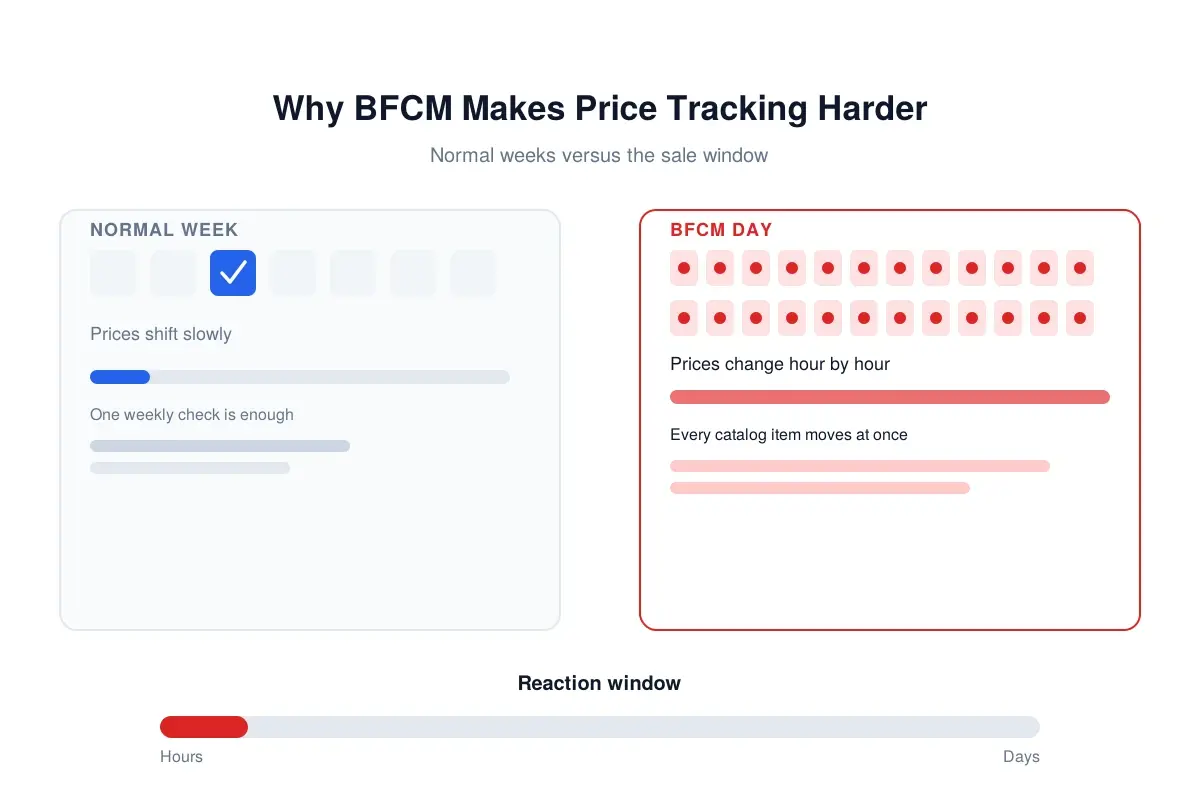
The same things that make BFCM lucrative make it difficult to track:
Prices change constantly, sometimes several times a day, with hourly deals and limited-time flash sales.
There is far more to watch, as competitors discount across their whole catalog rather than a few products.
Manual checking cannot keep up. A weekly spreadsheet check is useless when prices move hourly, so the methods that work in normal times break down.
Speed of reaction is everything, because a price advantage that takes you a day to spot is already gone.
The BFCM pricing game plan: before, during, and after
Tracking competitor prices during BFCM is really three jobs across three phases. Here is the shape of it before we go deeper:
| Phase | Focus | Key actions |
|---|---|---|
| Before | Prepare and set rules | Record baseline prices, set your margin floors, choose a tracking method, and plan your own deals |
| During | Track and react in real time | Monitor competitor prices frequently, watch flash sales and stockouts, and reprice within your floor |
| After | Review and reset | Revert sale prices, measure what worked, and note competitor tactics for next year |
Before BFCM: prepare now
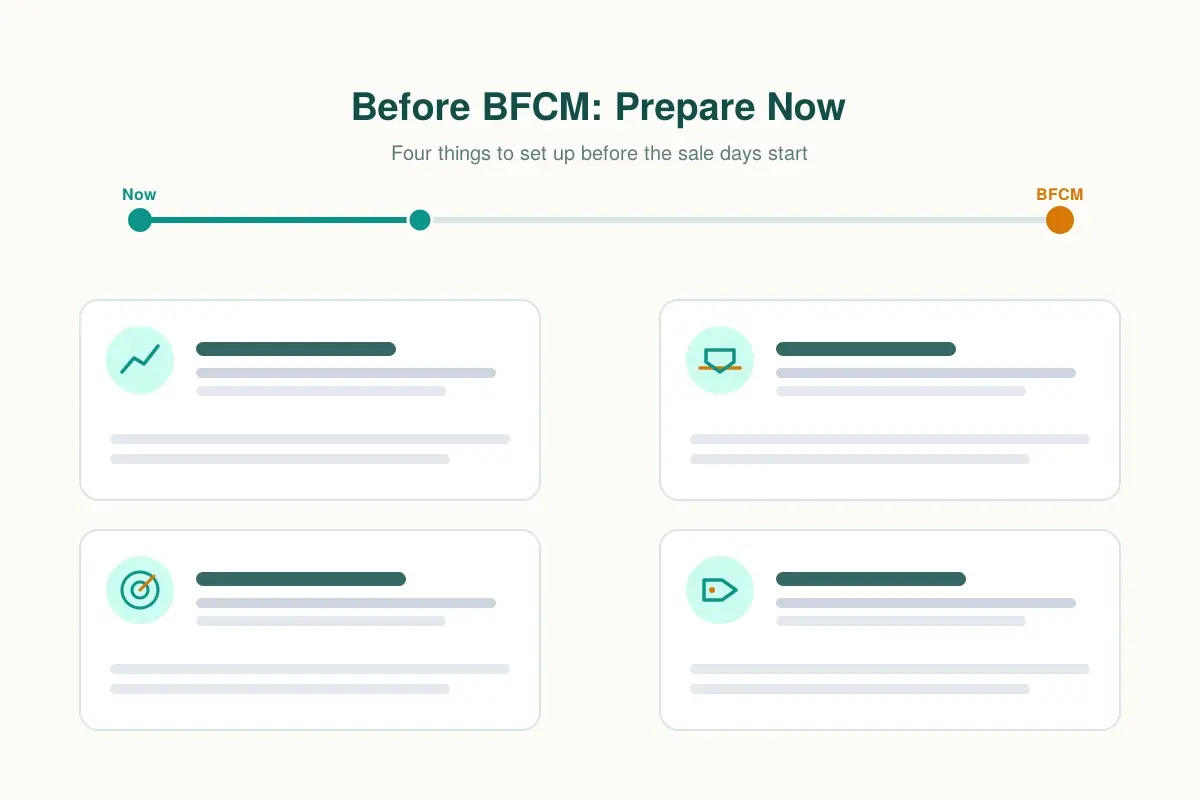
The stores that win BFCM on pricing do the work before it starts, not during. With the sale days almost here, this is the phase to act on immediately:
Record baseline prices. Note competitors’ normal, pre-sale prices on your key products now. Without a baseline you can’t tell a genuine BFCM discount from fake urgency, and you can’t judge how deep to go.
Set your margin floors. Decide the lowest price you are willing to sell each product for, so no amount of competitor discounting pulls you into a loss.
Choose your tracking method. Manual checks won’t survive BFCM’s pace, so set up an automated way to monitor competitor prices before the rush, not during it.
Plan your own deals. Decide your discounts and which products to promote in advance, informed by where competitors usually price.
During BFCM: track and react in real time
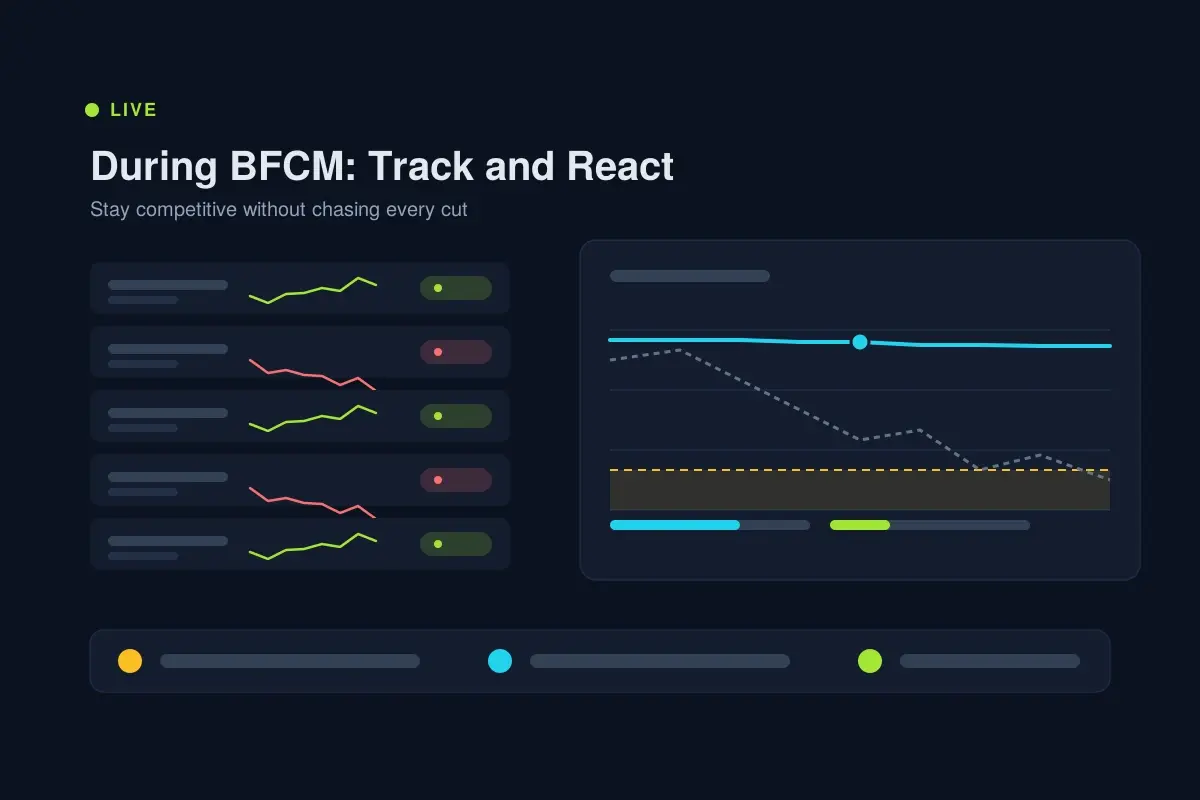
Once the sale is live, the game is speed and discipline. The goal is to stay competitive on the products that matter without chasing every cut off a cliff.
Monitor competitor prices frequently. Ideally in real time, so you see changes as they happen rather than hours later.
Watch for flash sales and hourly deals, which are short by design, so the value is in catching and responding to them quickly.
Track competitor stock. When a rival sells out of a shared product, that is your moment to hold or even lift your price and capture the demand.
React within your floor. Respond to competitor moves, but never below the margin floor you set, so you compete profitably rather than just cheaply.
Don’t blindly match every discount. Matching every cut is how margins vanish. Lean on your value and only respond where it genuinely wins the sale.
Because BFCM shoppers compare so heavily, this is also the moment an on-page price comparison pays off: when a visitor can see you are the better deal without leaving your product page, you convert them on the spot. Our guide on showing competitor prices on your product pages explains how.
Manual tracking can’t keep up with BFCM
It is worth being blunt about this. The free, manual methods that are fine for tracking a few products in a normal week fall apart during BFCM, when prices move by the hour across entire catalogs. By the time you finish checking competitor pages by hand, the prices you logged are already out of date.
This is exactly the scenario automated, real-time tracking is built for. Instead of checking manually, you get competitor prices monitored continuously, alerts the moment something changes, and repricing that responds within the rules you set, so you keep pace with a market moving faster than any person can watch. For ongoing competitor price monitoring, that automation is useful year-round, but during BFCM it becomes close to essential.
Using Price Mirror for BFCM
Price Mirror is built for exactly this kind of fast-moving pricing. It tracks competitor prices in real time, alerts you when they change, and reprices your products automatically within the margin guardrails you set, so you stay competitive through flash sales and hourly deals without watching screens all weekend. It can also show competitor prices on your product pages, which is especially powerful with BFCM’s price-obsessed shoppers.
To be clear on cost, since this is a tool rather than a free method: Price Mirror offers a 14-day free trial, with paid plans from $39 per month. With Black Friday only days away, the practical move is to start the trial now so your tracking and rules are set up and tested before the sale goes live, rather than scrambling once prices start moving.
Set up Price Mirror before Black Friday on the Shopify App Store →
After Cyber Monday: review and reset
When the sale ends, two things matter. First, revert your prices. If you lowered prices manually, make sure they return to normal on schedule, since a sale that quietly runs for an extra week eats margin you can’t get back. Second, review what happened: which pricing decisions won, where you were too aggressive or not aggressive enough, and what tactics your competitors used. Those notes are the head start for next year’s BFCM.
Common BFCM pricing mistakes to avoid
Racing to the bottom. Matching every competitor cut without a floor destroys the profit BFCM should make you.
Preparing too late. Trying to set up tracking once the sale is live means you are already behind.
Relying on manual checks. Human checking simply cannot match BFCM’s pace.
Forgetting to revert prices. Sale prices left running after Cyber Monday quietly cost you margin.
Frequently asked questions
When are Black Friday and Cyber Monday in 2026?
Black Friday 2026 is Friday, November 27, and Cyber Monday is Monday, November 30. In practice, many retailers run deals for a week or more around those dates, so competitor prices start moving well before Black Friday itself.
How do I track competitor prices during Black Friday?
Record competitors’ baseline prices beforehand, set your margin floors, and use automated real-time tracking to monitor changes during the sale, since prices move hourly. React to meaningful changes within your floor rather than matching every cut.
Can I track competitor prices manually during BFCM?
You can, but it rarely works well. BFCM prices change too fast and across too many products for manual checking to keep up, so the prices you log are often already out of date. Automation is far more practical during the sale period.
Should I match every competitor discount on Black Friday?
No. Matching every cut is the fastest way to destroy your margins. Set a floor price for each product, respond only where it genuinely wins the sale, and lean on your value rather than competing on price alone.
How should I prepare my pricing for BFCM?
Before the sale, record competitor baseline prices, set your margin floors, decide your own deals in advance, and get an automated tracking method set up and tested. Preparing early is what lets you react calmly once prices start moving.
The bottom line
During Black Friday and Cyber Monday, competitor prices move faster than any other time of year, and the stores that track them well win more of the season without sacrificing margin. Prepare now by recording baselines and setting your floors, track in real time once the sale is live, respond within your limits rather than chasing every discount, and reset cleanly afterward. With the pace BFCM moves at, automated tracking is what turns competitor pricing from a weekend of guesswork into a genuine advantage.