Shopify Price Intelligence: How to Use Competitor's Data to Make Better Pricing Decisions
Most Shopify stores price on instinct. They pick a number that feels right, add a margin, and revisit it only when something forces them to. The problem is that your market never stops moving, and instinct has no way of knowing when a competitor just undercut you or quietly left room for you to charge more. Shopify price intelligence replaces that guesswork with something far more reliable: real competitor's data, analyzed and turned into deliberate pricing decisions.
This guide explains what price intelligence actually is, what data feeds it, and, most importantly, how to turn competitor's data into better pricing decisions rather than just a dashboard of numbers you never use.
What is price intelligence?
Price intelligence is the practice of collecting and analyzing pricing data, especially competitor's data, to make informed pricing decisions. It goes a step beyond simply tracking prices. Tracking tells you what a competitor charges; intelligence is what you get when you analyze that data in the context of your own costs, margins, and positioning, and use it to decide what to do next.
Put simply, price intelligence is the bridge between raw data and a smart decision. Data on its own does nothing. Intelligence is data plus analysis plus action, and that is what actually moves your margins and conversions.
Why price intelligence matters for Shopify stores
For a Shopify store, price intelligence turns pricing from a set-and-forget guess into an ongoing advantage. It helps you:
- Protect margins by knowing exactly where you can hold a price rather than discounting out of fear.
- Stay competitive by seeing when a rival undercuts you on a shared product, so you can respond on your terms.
- Capture opportunities when competitors raise prices or run out of stock and demand shifts toward you.
- Decide with confidence because every pricing move is backed by market data instead of a hunch.
- React faster to market changes, catching them in near real time rather than weeks later.
What data powers price intelligence
Good pricing decisions draw on more than a single competitor price. The most useful inputs are:
- Competitor prices on the same or comparable products, the core of any price intelligence.
- Stock and availability, since a competitor selling out changes your position as much as a price cut.
- Promotions and sales, which create temporary pressure you may or may not want to match.
- Price history and trends, so you can tell a genuine shift from a short-lived blip.
- Your own costs and margins, which set the floor every decision has to respect.
Gathering this continuously, rather than checking now and then, is what keeps your intelligence current. That ongoing discipline is exactly what competitor price monitoring provides.
The price intelligence process
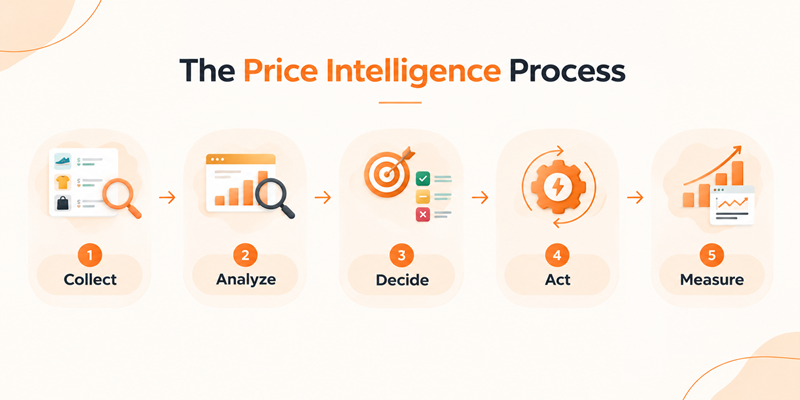
Turning data into decisions follows a repeatable loop. Each cycle sharpens the next.
- Collect. Gather competitor prices, stock, and promotions across your key products, continuously rather than occasionally.
- Analyze. Compare that data against your own prices and margins. Identify where you are the expensive option, the cheap option, or in line, and look at trends, not just today’s snapshot.
- Decide. Turn the analysis into a decision using clear rules: your margin floor, your positioning, and how you want to compete on each product.
- Act. Update prices, either manually or through automated repricing, always within your guardrails.
- Measure. Track the effect on conversion and profit, then feed what you learn back into the next cycle.
Turning competitor's data into pricing decisions
This is where price intelligence earns its name. The value is not in the numbers themselves but in what you do with them. Here is how common competitor signals translate into pricing moves:
| Competitor signal | What it tells you | Smart pricing move |
|---|---|---|
| A competitor drops the price on a shared product | You may now be the expensive option on that item | Match or beat within your margin floor, or hold and make your added value clear |
| A competitor raises their price | Headroom has opened up in the market | Hold to widen your margin, or raise while staying competitive |
| A competitor goes out of stock | Demand is shifting toward you | Hold or lift the price and promote that product while you can |
| You are consistently the cheapest | You may be leaving profit on every sale | Test a price increase and watch conversion and profit |
| A competitor launches a promotion | Temporary price pressure on that product | Decide whether to respond, wait it out, or counter with value |
| Prices across the market are trending up | Costs or demand are rising sector-wide | Move with the market rather than absorbing the squeeze |
Pricing strategies price intelligence supports
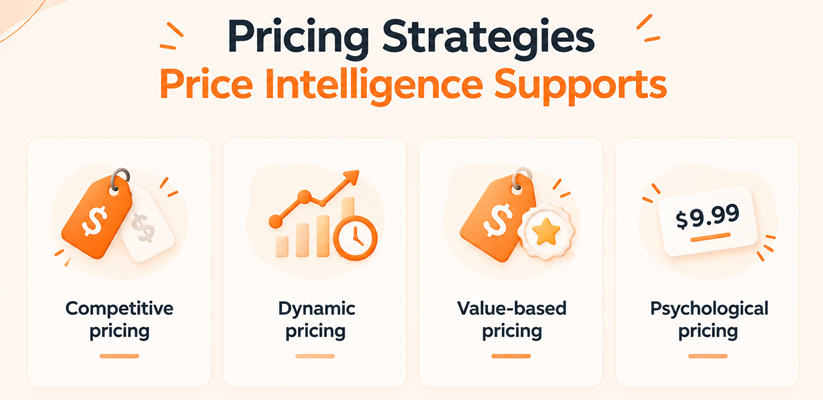
The same competitor's data can feed several pricing strategies, and most stores blend them:
- Competitive pricing: positioning your prices relative to rivals, whether that means matching, undercutting slightly, or deliberately sitting above.
- Dynamic pricing: adjusting prices automatically as competitor's data changes, within rules you set.
- Value-based pricing: using the data to confirm you can charge more where your product, brand, or service justifies it.
- Psychological pricing: pairing the right number with tactics like charm pricing and anchoring to lift perceived value.
How to use price intelligence well
Competitor's data is powerful, but only if you use it wisely. A few principles keep it working for you:
- Don’t race to the bottom. The goal is profitable competitiveness, not the lowest price. Always price within a margin floor.
- Prioritize the products that matter. Focus your intelligence on your highest-revenue and most-competitive items rather than every SKU at once.
- Combine data with value. A higher price can be the right call when your offering justifies it; let the data inform the decision, not dictate it.
- Keep it current. Stale data leads to bad decisions, so gather it continuously and act while it is fresh.
- Act on it. Intelligence you never use is just a report. The value comes from turning it into decisions.
Tools for Shopify price intelligence
You do not need an enterprise system to run price intelligence on Shopify. Your store analytics cover your own performance data, and a competitor price tracking app handles the external side, gathering, analyzing, and helping you act on competitor's data automatically.
Price Mirror is built around exactly this loop. It tracks competitor prices and stock in real time, keeps the history so you can see trends, applies margin guardrails, reprices automatically within your rules, and can even show competitor prices on your product pages so the intelligence works for shoppers too. It turns the process in this guide into something that runs in the background of your store.
Try Price Mirror free on the Shopify App Store →
If you want to compare the options first, our roundup of the best price comparison apps for Shopify weighs the main tools side by side.
Frequently asked questions
What is price intelligence?
Price intelligence is the practice of collecting and analyzing pricing data, especially competitor prices, to make informed pricing decisions. It combines data, analysis, and action, so you price based on what the market is actually doing rather than on guesswork.
What is the difference between price intelligence and price tracking?
Price tracking records what competitors charge. Price intelligence is the broader discipline of analyzing that data in the context of your costs, margins, and positioning, then using it to make decisions. Tracking is one input; intelligence is what you do with it.
How do I use competitor's data to set prices?
Start by gathering competitor prices on your key products, then compare them against your own costs and margins. Use the gaps to decide whether to match, beat, hold, or raise, always staying above your margin floor, and adjust as the data changes. The signal-to-move table above shows how common situations translate into decisions.
Is price intelligence only for big retailers?
No. It was once the preserve of large retailers with dedicated teams, but affordable Shopify apps now put the same capability within reach of small and mid-size stores, automating the data collection and analysis that used to require significant resources.
How often should I update my price intelligence data?
Continuously, ideally. Competitor prices, stock, and promotions can change daily, so automated monitoring that refreshes at least once a day keeps your decisions based on current data rather than a snapshot that is already out of date.
The bottom line
Price intelligence is what separates stores that guess at pricing from stores that decide with data. By collecting competitor prices, analyzing them against your own costs and positioning, and acting within clear guardrails, you turn pricing into a deliberate, repeatable advantage rather than a number you set once and hope is right. Start with your most important products, keep the data current, and, above all, act on what it tells you. That is how competitor's data becomes better pricing decisions.